
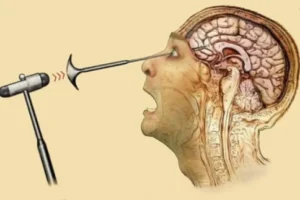
Let me take you back to 1946. A 29-year-old mother named Ellen Ionesco lies unconscious in her office in Washington D.C. Her crime? Being “violently suicidal” after postpartum depression. Walter Freeman II (a neurologist and psychiatrist with no formal surgical training) —jams an ice pick, yes, an actual ice pick. From his freezer. above her eyeball, wiggles it into her brain, and severs neural connections.
When she wakes, Ellen’s alive… but dimmed. Her family calls it a “success.” She stops trying to die but loses chunks of her memory, her spark, her self.
This wasn’t fringe science. Lobotomies won a Nobel Prize in 1949. By the 1950s, over 40,000 people—many women, children, and marginalized groups—had their brains altered by ice picks, drills, or leucotomes. Some “recovered.” Most became ghosts.
How Lobotomies “Worked”
Lobotomies targeted the frontal lobes—the brain’s control center for personality, judgment, and empathy. Surgeons didn’t just “calm” patients; they erased their humanity.
The Data:
- 91% of survivors had permanent personality defects: no initiative, no filter, childlike dependency.
- 12% developed epilepsy; 5% died mid-surgery (Tuft, M., & Nakken, K. O., 2017).
- Only 13% “fully recovered”—meaning they were quiet, docile, and easier to manage (British Medical Journal, 1954).
Freeman described his ideal patient as having the “personality of an oyster.” One woman post-lobotomy smiled blankly while pouring coffee from an empty pot, unaware of her own absurdity. Another gained 50 pounds in months, her hunger switch stuck on “endless.”
“They Turned Me Into a Zombie”: Survivors’ Voices
Howard Dully’s Story: At 12, Howard was labeled “defiant” for hating bedtime and daydreaming. His stepmother wanted him fixed. In 1960, Freeman—yes, the ice pick guy—lobotomized Howard through his eye sockets.
What followed? Decades of foster homes, alcoholism, homelessness. “I felt like I’d been erased,” he said. Miraculously, Howard rebuilt his life: college degree, school bus driver, bestselling memoirist. But his truth haunts: He spent 40 years not knowing why he’d been lobotomized. No psychosis. No violence. Just a stepmom who found him inconvenient.
Alys Robi: The “Success” Myth: A Canadian singer lobotomized after a mental breakdown in 1948, Alys credited the operation with her recovery: “I woke up better and later understood that I was one of the rare lobotomy success stories“. She resumed singing but never regained her fame. Was she truly healed—or just numb enough to function?
“She Lost Her Filter—and Herself”
Also, I recently fell into a Reddit rabbit hole on this topic, and the stories shared there… well, they’re equal parts heartbreaking and eye-opening.
One user shared their grandmother’s story. Decades after her surgery, the family discovered a shocking truth: that her “brain aneurysm treatment” had actually been a lobotomy. A chunk of her frontal lobe was gone. The result? She lost her sense of judgment, her mental filter, and any semblance of social grace. Imagine someone who speaks every rude thought that pops into their head, like they’re permanently tipsy. That’s how her granddaughter described her. Yet, paradoxically, when dementia set in later, she softened—becoming sweet, patient, the opposite of the agitation dementia often brings.
One nurse shared how an 87-year-old woman with Alzheimer’s, once riddled with anxiety, now lives blissfully in the moment. Another user’s grandmother spent her final years hosting imaginary dinner parties with Obama and the Queen.
Brain damage—whether from disease or a surgeon’s ice pick—can rewrite personalities in ways we’re still struggling to understand.
Could This Happen Again? A Futurist’s Warning
Scenario 1: The Algorithmic Lobotomy Imagine 2050: An AI scans your brain activity, flags “abnormal” emotions (anger, sadness), and prescribes a neural implant to blunt them. You’re calmer, yes—but also hollow. Corporations market it as “self-optimization.” Critics call it digital lobotomy.
Scenario 2: The Genetic Ice Pick CRISPR edits target “undesirable” traits—impulsivity, queerness, dissent—under the guise of “preventing suffering.” Sound extreme? Remember: Lobotomies were once called “compassionate.”
What Can We Learn from This?
Desperation breeds dangerous shortcuts. Lobotomies thrived in an era with few mental health treatments. Families were told, “This is your only option.”, it was quick, cheap, and lucrative. Today, we have better tools—therapy, medications, neuroimaging—but the lesson remains: question “miracle cures.”. Today? See: opioid epidemics, TikTok diagnoses etc. Personality is fragile. Whether it’s dementia, a lobotomy, or a stroke, damage to the brain can erase the person you once knew, “If someone’s behavior changes drastically, get their brain scanned.” Consent is everything. Most survivors didn’t choose this. They were women labeled “hysterical,” children deemed “defiant,” or bodies used as test subjects. Ethics matter. Lobotomies faded not because of moral outrage, but because antipsychotic drugs arrived in the 1950s. It’s a stark reminder: progress isn’t guaranteed. We have to fight for humane care.
When Howard Dully died on February 11, 2025, his obituary didn’t just mourn a man. It mourned the thousands whose minds were stolen by medicine’s hubris.
So next time you hear about a “breakthrough” psychiatric treatment, ask:
- Who benefits?
- What’s being erased?
- Could this be tomorrow’s lobotomy?
The answers might terrify you. But as history screams: Silence is how monsters win.
Want to dive deeper?
- Watch: The Lobotomist (PBS documentary)
- Read: My Lobotomy by Howard Dully
- Listen: NPR’s 2005 investigation into Freeman’s legacy
Got a thought? A family story? Share it below. Let’s keep these voices alive—because the second we forget history’s horrors; we risk repeating them.