

Why one of medicine’s most familiar tablet still resists a simple explanation
The idea for this article came to me during a fever.
The fever had left me exhausted, aching and too drained to get out of bed. After taking paracetamol, the fever began to ease. Started sweating, and soon standing up, drinking water and doing ordinary things felt possible again. I was not suddenly well, but being ill had become more manageable.
Since childhood, paracetamol had been part of almost every fever—a familiar tablet taken without much thought.
That familiarity followed me into my internship. I have seen paracetamol given for a mild fever on the ward and to critically ill patients in ICU. The situations are very different, but the drug is so routine that we rarely stop to ask how it works.
Yet when this fever made me ask what the tablet had done, I realised I could not give a satisfying answer.
Before I began writing, I mentioned the idea to a few friends in medicine. Their reaction was almost identical: what was left to write? We already know how paracetamol works.
That confidence is understandable. Search for “mechanism of paracetamol” and an answer appears in seconds.
Told them I would finish the article and send it—not to prove the familiar answer wrong, but to show what it leaves out.
The expected answer
Most of us expected the answer to be simple: paracetamol reduces prostaglandin production in the central nervous system. For fever it makes reasonable sense.
During an infection, immune signals cause the hypothalamus to raise the body’s temperature set point. We may feel cold and shiver even while our temperature is rising. Paracetamol appears to reduce prostaglandin signaling around the hypothalamus, allowing that set point to fall. The body can then release heat through the skin as sweat.
That was probably what had happened to me. The tablet had not treated the illness; it had lowered the temperature my body was trying to maintain and made the illness easier to tolerate.
Pain was where the simple answer began to break down. Paracetamol is described as a COX inhibitor, yet it behaves very differently from ibuprofen. It relieves pain and fever but has little anti-inflammatory effect, and in laboratory tests it can appear too weak against COX-1 and COX-2 to explain what it does in people. If it was such a weak inhibitor, why did it work at all?
One tempting answer appeared in 2002, when researchers identified a paracetamol-sensitive COX-1 variant in dog brain and called it COX-3. A brain-associated COX enzyme seemed to explain everything neatly. But related human variants did not produce an equivalent active, paracetamol-sensitive enzyme. COX-3 remained an interesting discovery in dogs, not the missing human target.
A 2005 cell study suggested another explanation. Paracetamol inhibited COX activity while the enzyme remained inside an intact cell, but the effect disappeared when the cell was broken apart. It also disappeared when researchers made the inside of the cell more oxidising.
Why did that matter? An intact cell preserves the chemical environment in which COX normally operates. The experiment suggested that paracetamol’s effect depends partly on that environment, rather than on simply switching the enzyme off wherever it finds it.
Put simply, paracetamol seems better able to interrupt prostaglandin production when peroxide levels are relatively low, as they are in parts of the central nervous system. The higher peroxide levels in inflamed tissue may overcome that effect. This could explain why paracetamol reduces fever and pain without behaving like a strong anti-inflammatory drug. It explains the pattern, but not the whole mechanism of pain relief.
While trying to understand what was missing, I opened a review with a title that immediately caught my attention: What do we (not) know about how paracetamol works? Then I noticed its publication year: 2010. If researchers were still asking the question so openly in 2010, surely the years since had produced a clearer answer. I kept reading.
What I found was not one final mechanism, but more pieces. A small amount of paracetamol can be converted into p-aminophenol and then, in the brain and spinal cord, into AM404. This metabolite activates TRPV1, a channel involved in heat and pain, and influences endocannabinoid signaling. That does not make paracetamol cannabis-like; it means one of its metabolites may use some of the same internal systems involved in regulating pain.
Serotonin offered another clue. In a 2006 experimental pain study involving 26 healthy men, paracetamol’s measured analgesic effect disappeared when drugs blocking certain serotonin receptors were given, even though its concentration in the blood did not change. The result suggested a role for descending serotonin pathways—signals from the brain that can dampen incoming pain—but did not make serotonin the whole answer.
Later findings kept the question open. In 2017, researchers detected AM404 in the cerebrospinal fluid of 17 of 26 men after intravenous paracetamol, although the concentrations were too low to show how much it contributed to pain relief. In 2025, laboratory and animal research suggested that AM404 may also block pain-related sodium channels in peripheral nerves. Each finding moved the story forward without closing it.
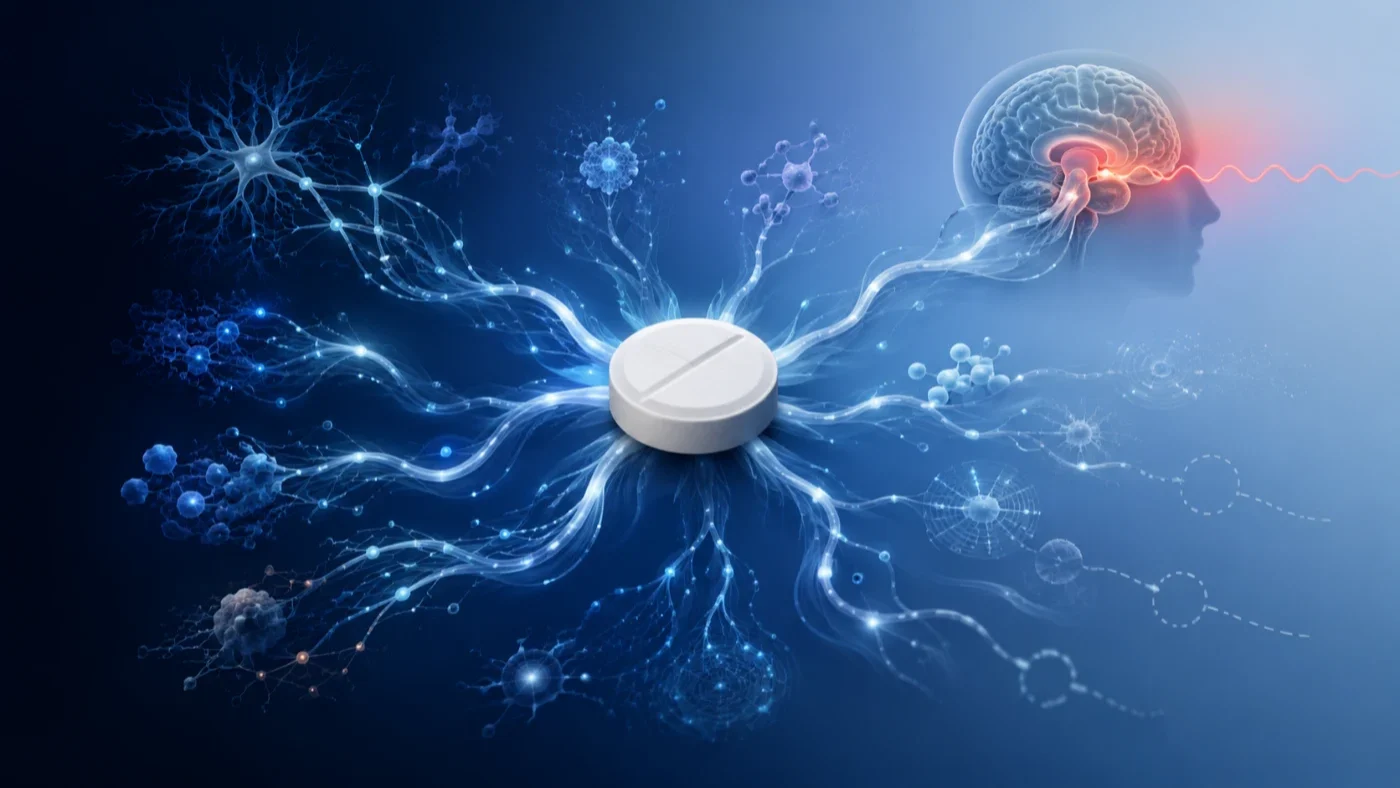
I had expected one mechanism. Instead, I found several partial explanations: central prostaglandins, the chemical conditions around COX, AM404, TRPV1, endocannabinoid signaling, serotonin and perhaps peripheral sodium channels. They may be different parts of the same answer.
The familiar explanation is not wrong. It is incomplete. We know what paracetamol does clinically; what remains unsettled is how much each pathway contributes when a person actually takes it.
A medicine that had to be rediscovered
One historical account begins not with paracetamol, but with the wrong medicine. In 1886, a patient in Germany was supposed to receive naphthalene for intestinal worms. A pharmacist reportedly dispensed acetanilide instead—a chemical from the dye industry. The worms remained—but the fever disappeared.
That error turned acetanilide into a fever medicine. It worked, but it could also cause methaemoglobinaemia, in which haemoglobin is oxidised into a form that can no longer bind oxygen, producing cyanosis. Chemists looked for safer relatives. In 1887, physician Joseph von Mering tested paracetamol in patients. It relieved pain and fever, but in 1893 he misinterpreted and reported that it could also cause Cyanosis. Phenacetin appeared to offer the same benefits without that danger. With a seemingly safer alternative already available, his conclusion went largely unchallenged and paracetamol was set aside.
Nearly sixty years later, researchers asked a different question: what did the body turn acetanilide and phenacetin into? They found that the body converted both into paracetamol, and that paracetamol was responsible for much of their pain- and fever-relieving effect. The methaemoglobinaemia associated with acetanilide was linked mainly to another metabolite, phenylhydroxylamine—not to paracetamol. Paracetamol had worked. The blood toxicity had simply been blamed on the wrong molecule.
Does every fever need it?
No. Fever is a physiological response, not a diagnosis.
Paracetamol can reduce fever, pain and discomfort. That may help someone rest, drink fluids or function. This is a real benefit even though the medicine does not treat the underlying illness. It does not kill the virus causing a common cold, and lowering the temperature does not automatically change the course of an infection.
Someone who is comfortable, hydrated and able to rest may not need medicine merely to produce a lower number. When fever or body pain is making those things difficult, paracetamol may offer useful symptom relief for a person who can take it safely. Age, medical conditions, other medicines and warning symptoms still matter.
Familiarity also makes carelessness easier. Official product information is clearer about paracetamol’s metabolism than about its pain mechanism: most is processed through relatively safe pathways in the liver, while a small amount becomes the toxic metabolite NAPQI. Glutathione normally neutralises it. In overdose, that protection can be overwhelmed and serious liver injury can follow. Accidentally combining different cold-and-flu products containing paracetamol is one way people can take more than they realise.
Paracetamol is therefore neither a miracle drug nor an unknowable mystery. It is a useful medicine with established effects, clear limits and a mechanism that remains incompletely understood.
I began by asking what one tablet had done during my fever. The answer was more modest than “it made me well,” but more interesting than “it lowered my temperature.” It changed pain and temperature signaling enough to make being ill easier, through pathways we understand in pieces rather than as one complete explanation.
That is what I gained from looking again at a medicine I had stopped questioning: familiar use is not the same as complete understanding.