
It can control selected cells using light and has transformed neuroscience. But there is a large gap between changing how we study the brain and changing how we treat patients.
I had read about optogenetics before it won the Nobel Prize. The idea was memorable: genetically make selected cells responsive to light, then use light to control their activity. Clever technology. Interesting neuroscience. I understood the broad idea and moved on, as we do with hundreds of other things in medicine.
Then it won the 2026 Nobel Prize in Physiology or Medicine.
So I went back – not because the science had suddenly changed overnight, but because the prize forced a more uncomfortable question: what was I underestimating here?
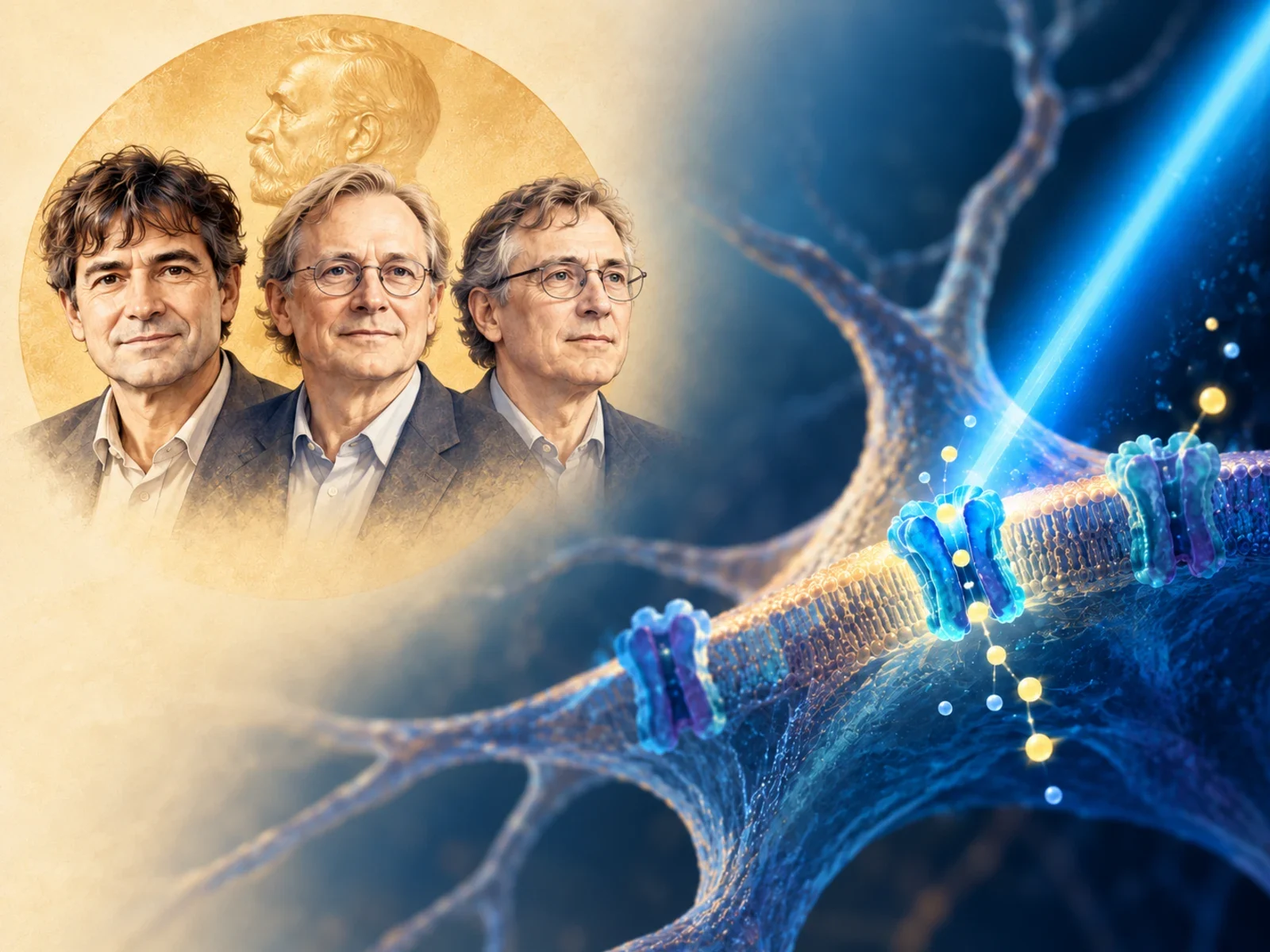
Karl Deisseroth, Peter Hegemann and Georg Nagel were awarded the prize for discoveries concerning light-gated ion channels and optogenetics. The foundational work was already about two decades old, and optogenetics had become central to modern neuroscience. This was hardly a fashionable new invention that happened to impress a Nobel committee. Scientists had been expecting Nobel recognition for years.
But Nobel-worthy science and useful medicine are not the same thing. So there are really two questions: why did this deserve the Nobel Prize, and can it actually do anything useful for patients?
The light is not the impressive part
Optogenetics sounds more futuristic than it actually is. Some microorganisms naturally contain proteins that respond to light. Work on the green alga Chlamydomonas helped identify channelrhodopsins – membrane proteins that move ions when illuminated. In 2003, Nagel and colleagues characterised Channelrhodopsin-2 as a directly light-gated cation channel.
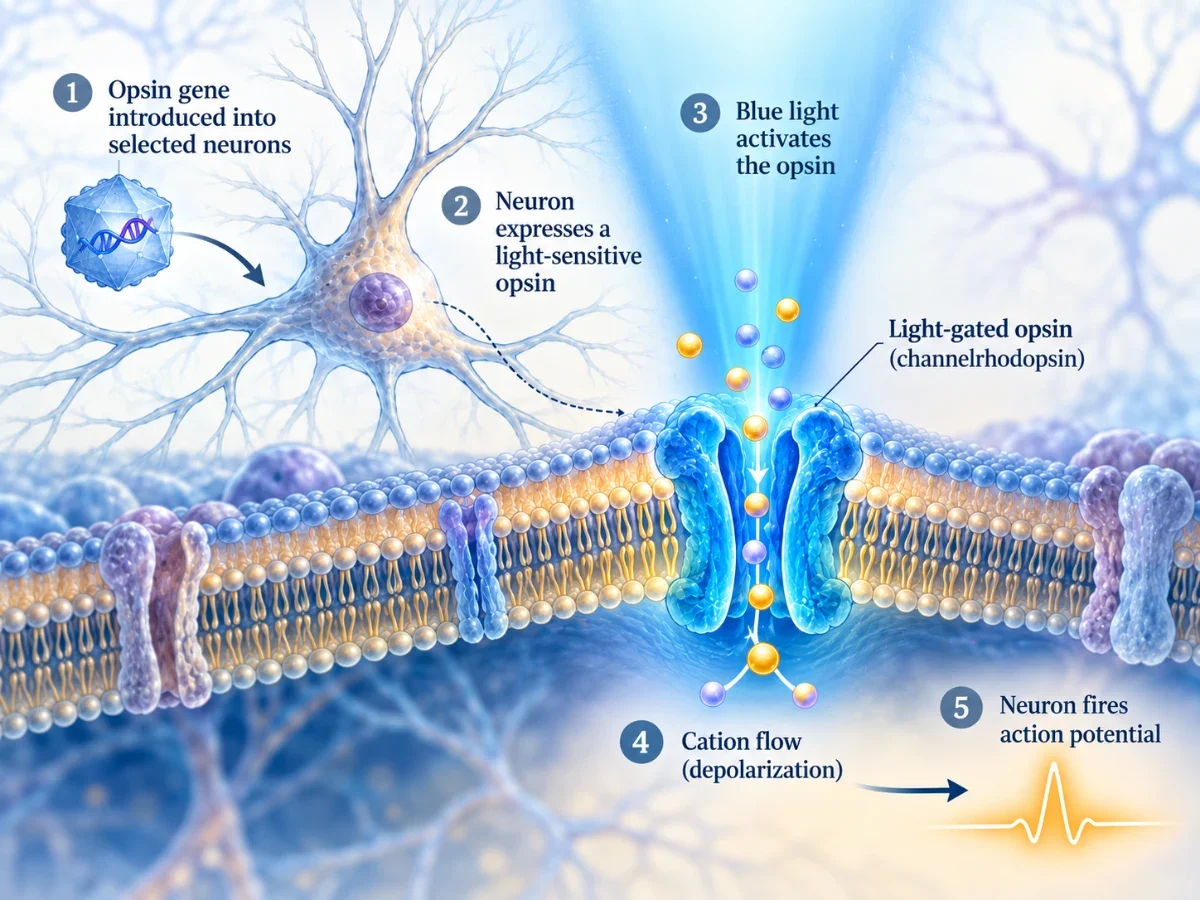
Then came the important trick: put the gene for one of these proteins into a neuron. The neuron can now respond to light.
In 2005, Boyden, Zhang, Bamberg, Nagel and Deisseroth demonstrated reliable, millisecond-timescale optical control of neuronal activity. From there, researchers built an expanding toolkit for activating and suppressing selected cells.
“Scientists control the brain with light.” Excellent headline. Slightly terrible explanation.
Making a neuron fire with light is not, by itself, the Nobel-worthy part. Being able to choose which neurons fire is.
Neuroscience had a causation problem
Imagine a group of neurons becomes active whenever an animal experiences fear. Are those neurons producing the fear, responding to it, controlling movement during it, or doing something else entirely?
Watching the brain is not the same as understanding what causes what inside it. Electrical stimulation helps, but electricity is not particularly polite: it can affect different cells, nearby structures and fibres passing through the same area.
Optogenetics made a different experiment possible. Make one defined population of cells light-sensitive. Switch it on. Watch what changes. Switch it off. See whether the effect disappears. And do it on the millisecond timescale at which neurons communicate.
That moves the question from “these neurons are active when this happens” towards “changing these neurons causes this to happen.”
So let me be clear: the science is not overhyped. Even if nobody ever routinely treats a human brain with optogenetics, the tool has already changed neuroscience.
No, we are not about to treat every brain disorder with a flashlight
This is where enthusiasm can get ridiculous. Parkinson’s disease? Control the motor circuit. Epilepsy? Silence the seizure circuit. Depression? Fix the relevant pathway. If only brains had the decency to behave like wiring diagrams.
Direct treatment is much harder. You first have to get genetic material into the correct human cells and make them reliably express a light-sensitive protein. Then you have to get light to those cells. A retina is one thing. A tiny neural population buried deep inside a human brain is another.
You may need implanted hardware. Gene delivery has to be specific and durable. Immune responses and long-term safety matter. And after solving all that engineering, there remains the annoyingly important medical question: does manipulating that circuit actually make the patient’s life better?
A major 2025 translational roadmap lays out these barriers, including indication selection, molecular and optical specificity, delivery, safety, immune responses and regulation.
So when optogenetics is mentioned alongside Parkinson’s disease, addiction, depression or epilepsy, we need to separate “this has taught us something important about the disease” from “we can treat patients this way.” Those are nowhere near the same claim.
Then there is the eye
This is where dismissing optogenetics as laboratory science stops working. In retinitis pigmentosa, photoreceptors progressively degenerate, but other retinal neurons can survive. Researchers asked a wonderfully simple question: if the natural light-detecting cells are gone, could we make some of the surviving cells detect light instead?
In 2021, researchers reported partial recovery of visual function in a blind patient after optogenetic therapy. A viral vector made retinal ganglion cells express the light-sensitive protein ChrimsonR, while special goggles processed the visual scene and projected suitable light patterns onto the retina.
With the treated eye and goggles, the patient could perceive, locate, count and touch objects that he had previously been unable to visually detect. Normal vision restored? No. Blindness cured? No. Measurable functional vision produced in a human being? Yes.
A 2026 review describes optogenetic vision restoration as moving from proof of concept into an expanding clinical pipeline, while still facing major problems such as light sensitivity, immune responses, targeting and clinical endpoints.
In September 2026, Nanoscope Therapeutics announced that the US FDA had accepted and filed the Biologics License Application for MOGENRY, an investigational optogenetic gene therapy for severe vision loss associated with retinitis pigmentosa. Acceptance means formal regulatory review; it does not mean approval.
So direct clinical optogenetics is not science fiction anymore. It is also nowhere near routine medicine. Both statements can be true.
The treatment may not even need to be optogenetic
This, to me, is where the medical importance becomes bigger. Suppose optogenetics identifies a very specific circuit responsible for a pathological behaviour. The eventual patient does not necessarily need an opsin, a viral vector and a light source implanted in the brain.
Researchers may instead use that knowledge to improve deep-brain stimulation, identify a drug target, refine electrical neuromodulation or develop another therapy entirely. Optogenetics can be valuable because it tells us where the problem is and what happens when we intervene there.
The 2025 roadmap makes this point explicitly: many medically important applications may be indirect, using causal knowledge from optogenetic experiments to guide completely different treatments.
That is less cinematic than controlling someone’s brain with blue light. It is also probably more medically important.
So, is optogenetics overhyped?
The science isn’t. The clinical promise sometimes is.
Optogenetics has already changed what neuroscientists are capable of asking about the nervous system. Direct therapy is a different matter. Retinal disease proves that the technology can cross into human treatment, but pretending we are on the verge of routinely treating Parkinson’s disease, epilepsy or psychiatric illness by switching neurons on and off with light would be selling a future that has not arrived.
The Nobel Prize did not recognise a miracle treatment. It recognised something more fundamental: a tool that changed our ability to figure out which cells and circuits actually matter.
Optogenetics has already changed neuroscience. Whether it changes the clinic just as dramatically is the experiment that is still running.